
Search Sienna Resident Records
There is no single public list of every person in Sienna. Fort Bend County keeps the records that connect an address to a parcel, recorded instrument, court file, or voter registration. Missouri City has a separate address-based permit route for addresses inside its jurisdiction. The strongest result matches at least two independent details, such as a full name and parcel address, or a name and a recorded instrument date. A parcel owner, a deed party, and an occupant are not interchangeable roles.
Begin with the narrowest reliable fact. A current address works well in the appraisal roll and county GIS. A name can be tested in the deed index, court search, or licensed-professional search, but each result needs context. Historic questions often require the George Memorial Library or the Texas State Library microfilm guide. Utility, protected-address, and other private data are not a public substitute for those sources.
For a Sienna address, write down the street number, street name, directional or suffix, ZIP, subdivision, and county before searching. The same community can appear as Sienna, Missouri City, or Rosharan in a mailing line. A village name can be more useful than a broad community keyword. Keep a search log with the source, date, parcel or case number, and the field that supports the result. That log makes a later correction possible and distinguishes a repeatable record check from a loose name match.
- Check the address or owner in the Fort Bend Central Appraisal District record and preserve the situs address, subdivision, and parcel identifier.
- Use county GIS to compare the parcel boundary, nearby layers, and the correct jurisdiction.
- Search the County Clerk index by grantee, grantor, or instrument number when a transfer or legal description matters.
- Use the voter tool only for a lawful current-registration check, then respect protected-address limits.
- For an older household, move to library directories, newspapers, microfilm, or a focused Texas Public Information Act request for existing records.
Sienna Resident Records Desks
Sienna is a planned community and Census-designated place, not the county seat or a separately incorporated city. That makes Fort Bend County the primary keeper of property, recorded instruments, county-court matters, and many vital records. The appraisal district identifies the current parcel, while the County Clerk keeps the official record index and copies. Elections maintains its own registration route. Missouri City sources matter only after an address is confirmed as being in that jurisdiction.
Use the office that owns the record. The appraisal roll is useful for property identity but is not title proof. A County Clerk index entry points to an instrument, while an image or certified copy carries more weight. Elections data is limited by statute. For a full address-by-address workflow, use the Sienna street directory.
The County Clerk's online library covers millions of documents from 1838 forward, while county and court material reaches into earlier historic series. The Tax Assessor-Collector is a separate office from FBCAD: its tax routes address statements, rates, payment, and tax certificates, while FBCAD supplies appraisal and parcel fields. Historic district-court books move through Kofile and microfilm. Selecting the wrong office can make an available record look absent, particularly when a case, tax issue, or deed is being searched through an appraisal screen.
Fort Bend Central Appraisal District
Parcel and appraisal records
Fort Bend County, TX
Use the current district contact page
Sienna Parcel Search Fields
FBCAD eSearch is the practical first stop when an address or owner name is known. It accepts owner name, street number, street name, Quick Ref ID, Geographic ID, subdivision, neighborhood, property type, tax year, and other advanced controls. Its own help advises simplifying a failed address by using the street name, then street plus numbers, or omitting the street type. Quick Ref ID is the fastest exact route.
| FBCAD field | Useful Sienna purpose |
|---|---|
| Street Number and Street Name | Narrows a known parcel address |
| Subdivision or Neighborhood | Helps distinguish Sienna village names |
| Quick Ref ID | Direct parcel route from a notice or tax bill |
| Geographic ID | Connects a parcel to legal and map work |
The appraisal result can show owner, mailing address, situs address, value, legal description, taxing units, and historical fields. A situs address is the physical parcel location. A mailing address is correspondence information, and the two can differ.
FBCAD describes its 2026 roll as certified while warning that some values can still change. Its map can omit mineral, mobile-home, and personal-property categories. A homestead indicator may support a narrow owner-occupancy inference, but it does not identify everyone in a household and its absence does not prove non-occupancy. Treat the appraisal values and acreage as appraisal-use information, then verify a disputed legal description or ownership question in the recorded instrument and current custodian files.
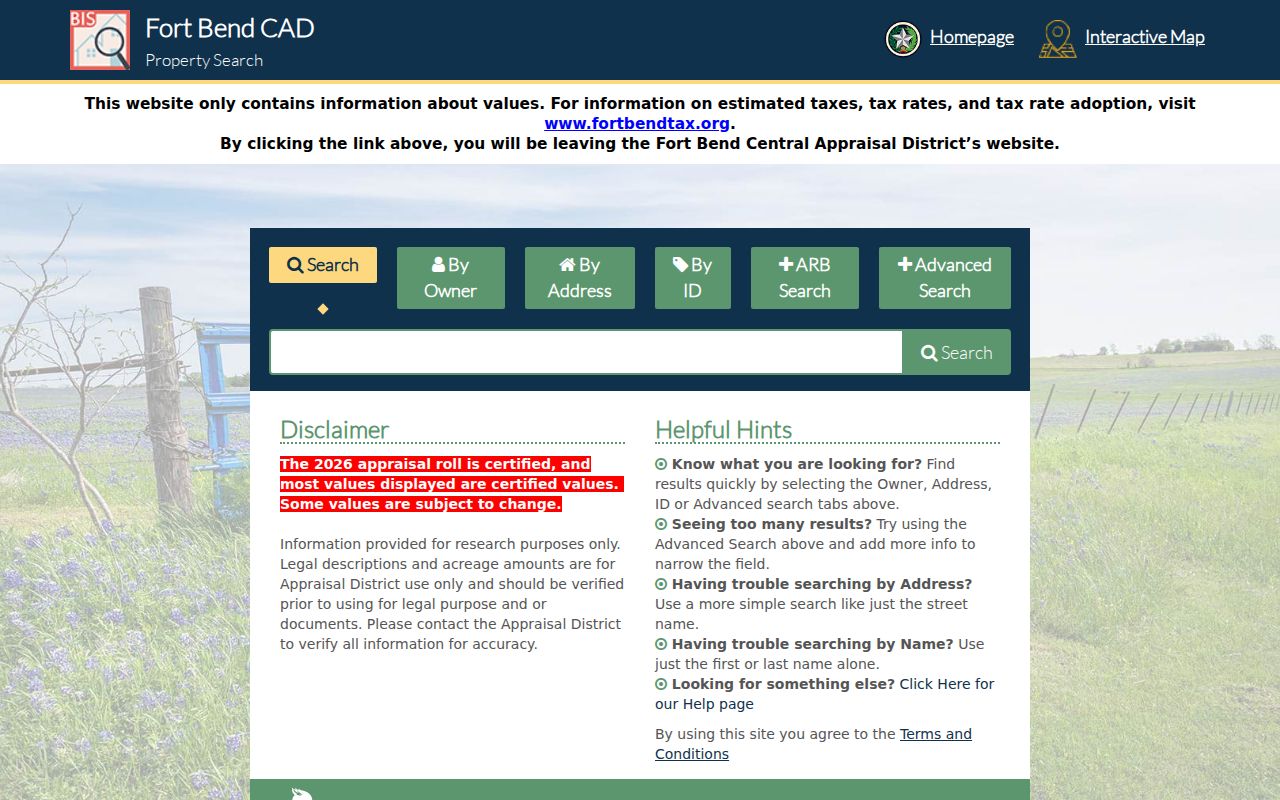
The captured FBCAD search screen shows why an address search can be narrowed before it is treated as a household finding.
Sienna Deed Index Trail
The Fort Bend Official Public Records index is a name and instrument trail, not a resident roster. At inspection, its Permanent Index displayed coverage from January 1, 1838 through August 26, 2026. Search by party name, grantor, grantee, filing date, instrument number, or document type. A broad result can stop at 500 matches, so a date, document type, or legal-description clue is worth adding.
A grantor is the transferor in an instrument, while a grantee is the recipient. Starting with a current grantee, then locating that person's prior grantor entry, can establish a careful chain of title. Images may be unavailable during backup, and an unofficial printed image is not a certified copy. The Clerk can provide the relevant copy route when the instrument number is known.
Deeds, mortgages, easements, liens, plats, powers of attorney, bills of sale, and assumed-name filings do not make the same claim. A deed may include a legal description, lot and block, subdivision, plat reference, and parties to a transaction. It does not list each resident. When an address changes shape or street wording, bridge the records through the same subdivision and legal description. The County Clerk's records division, library microfilm, and historical projects are the documented fallback channels when an older index image is incomplete.
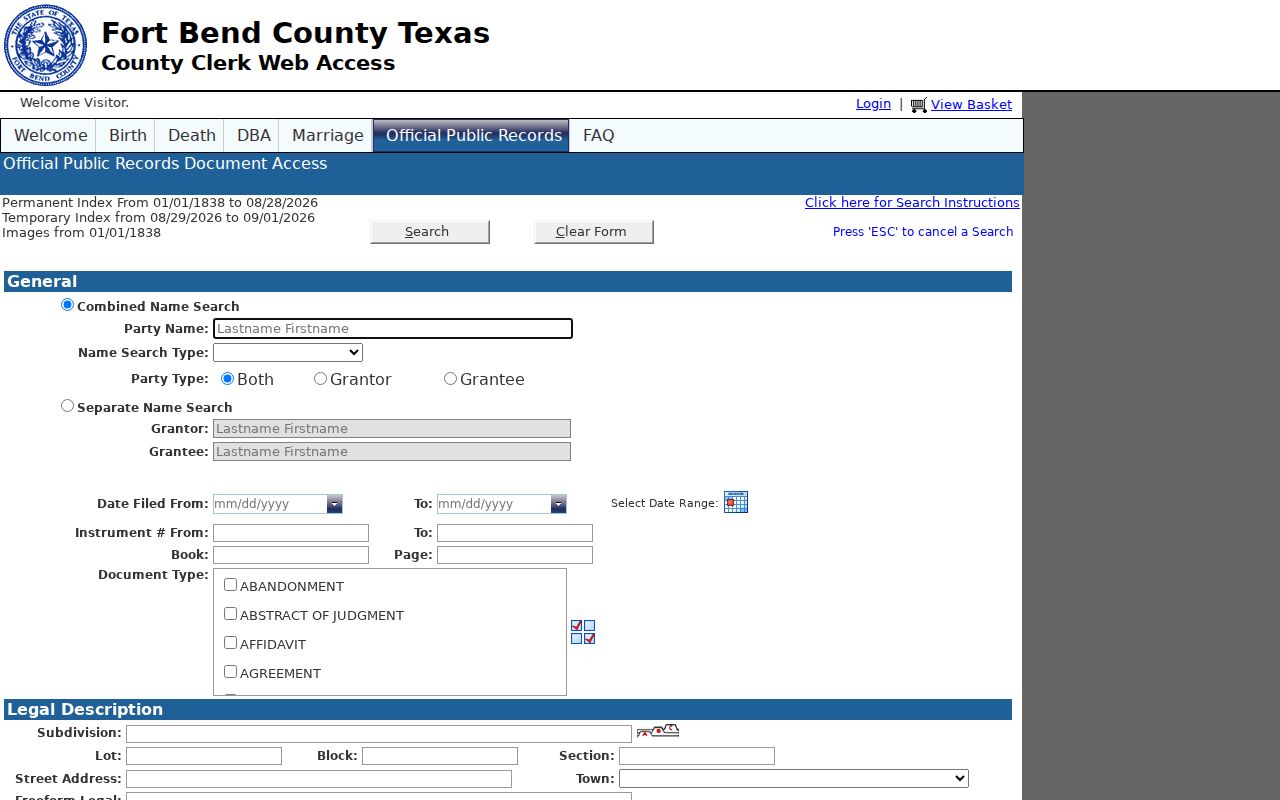
The County Clerk index screen is a starting point for instrument research, not proof of every person who has lived at an address.
Sienna's Two Postal Contexts
Sienna is not one simple map. Official sources document core Sienna addresses under Missouri City 77459 and southern Sienna-area addresses under Rosharan 77583. A 2026 Missouri City planning packet places Sienna Lakes Drive in Missouri City 77583. The association office and county election street-range material use 77459. A ZIP code, Census CDP, MUD, association boundary, and city service area answer different questions.
Use the USPS address lookup for the final postal assignment, then compare the county parcel service and FBCAD record. A 77583 mailing line does not erase Sienna context, and a city-map miss is not a Fort Bend County-record miss. This boundary check prevents a false no-result before any name research begins.
FBCAD does not expose ZIP as a named field in the inspected form, and the county voter interface is a person or VUID tool rather than a ZIP-wide directory. The Texas Department of Licensing and Regulation registered-license search has city, county, and ZIP filters, while the Texas HOA management-certificate search has a ZIP filter. Those results identify licensed or association filing context, not a complete set of residents. The right sequence is complete address, USPS, county parcel map, and then the relevant city or association layer.
The public parcel service supplies polygon and owner-display context, while the exact delivery ZIP still depends on the full address.
Fort Bend Court Name Checks
When a name needs a court-record check, Tyler Odyssey public access is the county route for civil, family, probate, and misdemeanor searches. The current instructions describe case number, party name, attorney, and filing-date fields. A blue case number opens case detail, and the Register of Actions can show public party information, events, orders, and financial information.
Coverage and access differ by docket. County guidance describes civil and misdemeanor routes from 1983 and probate from 1987, while historic District Clerk material uses Kofile and may require an account or purchase. Sealed, juvenile, protected-family, and redacted material cannot be inferred from a blank result. A case index also is not a finding about current residence.
County civil instructions direct searchers through the online record route to Civil and Family Case Records; separate instructions cover misdemeanor and probate records. For historic Fort Bend material, Kofile can use record type, year, party, last-name initial, first-name initial, or a book, volume, and page search. Electronic and paper copy paths depend on the clerk and whether certification is needed. A court event establishes only what the public record actually shows, so read the disposition or order before making a claim about a person.
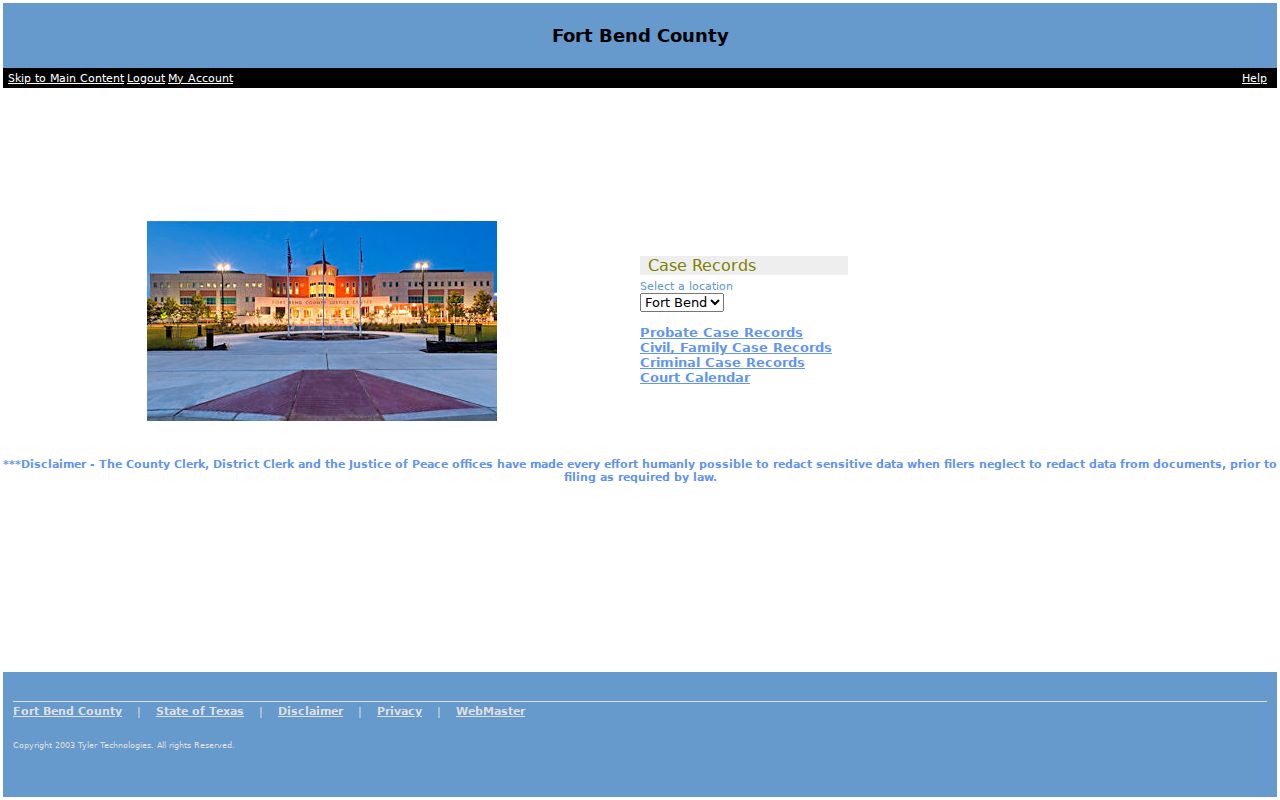
The Odyssey gateway illustrates the county court search handoff that complements, rather than replaces, parcel and deed research.
Current Sienna Resident Sources
Current sources answer different, limited questions. The FBCAD appraisal roll identifies a parcel owner and the County Clerk index identifies parties to a recorded filing. The Fort Bend registration tool confirms only the information that Texas law makes available. Sienna association materials describe villages, declarations, board minutes, and budgets, but the resident intranet is password protected and is not a public membership directory.
| Sienna source | What it can establish | Custodian | Access route |
|---|---|---|---|
| FBCAD appraisal roll | Owner, parcel, situs, mailing and value fields | FBCAD | Public eSearch |
| County OPR index | Recorded instrument parties and filing data | County Clerk | Public index, copies vary |
| View My Registration | Limited current registration confirmation | Fort Bend Elections | Statute-limited lookup |
| County court gateway | Public case-party and docket trail | County Clerk courts | Odyssey, Kofile for history |
| Sienna documents | Association and village governance context | SRA and SCA | Public resource library |
A name needs an address anchor and a date before it becomes a strong match. A current owner is not automatically a current resident, and an association document is not proof of membership. A one-person Sienna resident lookup uses that verification sequence without turning it into a roster.
State and county resources can also supply carefully limited corroboration. SOSDirect may show an entity, registered agent, governing person, or filing history, and TDLR or TEA searches can verify an official credential. Those roles are affiliation records, not residence proof. The Comptroller's unclaimed-property search is a former-name lead, not a current address source. When a name appears in several sources, compare date, county, subdivision, address, and record role before treating the entries as one person.
Sienna Voter Record Limits
Fort Bend's View My Registration uses a required search-method selector and accepts the live tool's VUID or name route, with date of birth where required. Texas Election Code chapters 13, 15, and 18 make specified registration information public, but ballot choices, Social Security numbers, driver-license and DPS identifiers, and protected residence details are not part of that public result.
A statewide voter-file request has its own written request and affidavit requirements. Election Code section 18.066 bars use of the requested list to advertise or promote a commercial product or service. Address-confidentiality programs and statutory affidavits can suppress a residence. A missing address should be treated as a privacy outcome, coverage issue, or search mismatch, never evidence that someone is unregistered.
The county elections office lists a registration lookup, precinct map, and election-result or map archives, alongside its contact channels. Texas law identifies public registration fields such as a voter name, address or permitted mailing address, birth year, precinct, registration date, registration number, and participation history, subject to statutory protection. Texas does not register voters by party, and participation is not a ballot choice. Limit a search to the official question being asked and do not republish a block-level file as a resident directory.
Sienna Family History Handoff
George Memorial Library's genealogy and local-history room is the right handoff when a current Sienna address reaches an older land, family, cemetery, or newspaper question. The room offers county burial records, microfilm readers, local reference materials, and staff help. Its library databases include in-library Ancestry Library Edition and Newspapers.com Texas Edition, described with Texas coverage from 1842 through 2024.
The burial database and printed cemetery volumes are volunteer-based leads, not certified vital evidence. Microfilm and archive work can be decisive when an online portal shows only an index. Sienna Branch is a convenient local library touchpoint, while George Memorial concentrates the specialized materials in Richmond.

The George Memorial screen identifies the local-history bridge from modern Sienna parcels to historic county records.
George Memorial's county burial database can supply cemetery, burial date, cemetery name, and transcription leads. Five Registry of Cemeteries in Fort Bend County volumes were published in 1997, with a supplement in 2004 and another supplement in progress at inspection. These materials must be checked against a certificate, cemetery, probate, or original source when a date matters. The room's microfilm readers and printers provide a practical fallback for older deed, probate, tax, and court series that do not appear as a complete web image.
Sienna Archive Gaps Matter
Fort Bend's record trail is layered rather than uniformly online. The Historical Commission archive preserves documents, photographs, artifacts, cemetery and family-history material, including the Knight & White Papers. Its archive search uses keyword, category, subcategory, and historical-period controls, but the research notes that it is dynamic and may need a live session. Contact the archive before a visit.
Some gaps are documented. Commissioners Court Book B, covering 1869 through 1881, is missing, and historic deed material has a missing-page warning for Volume D plus a duplicate or transcription issue for Volume F. An index lead can still be valuable, but it should be labeled as an index, image, certified copy, transcription, or archival reference. That distinction keeps a blank result from becoming a false conclusion.
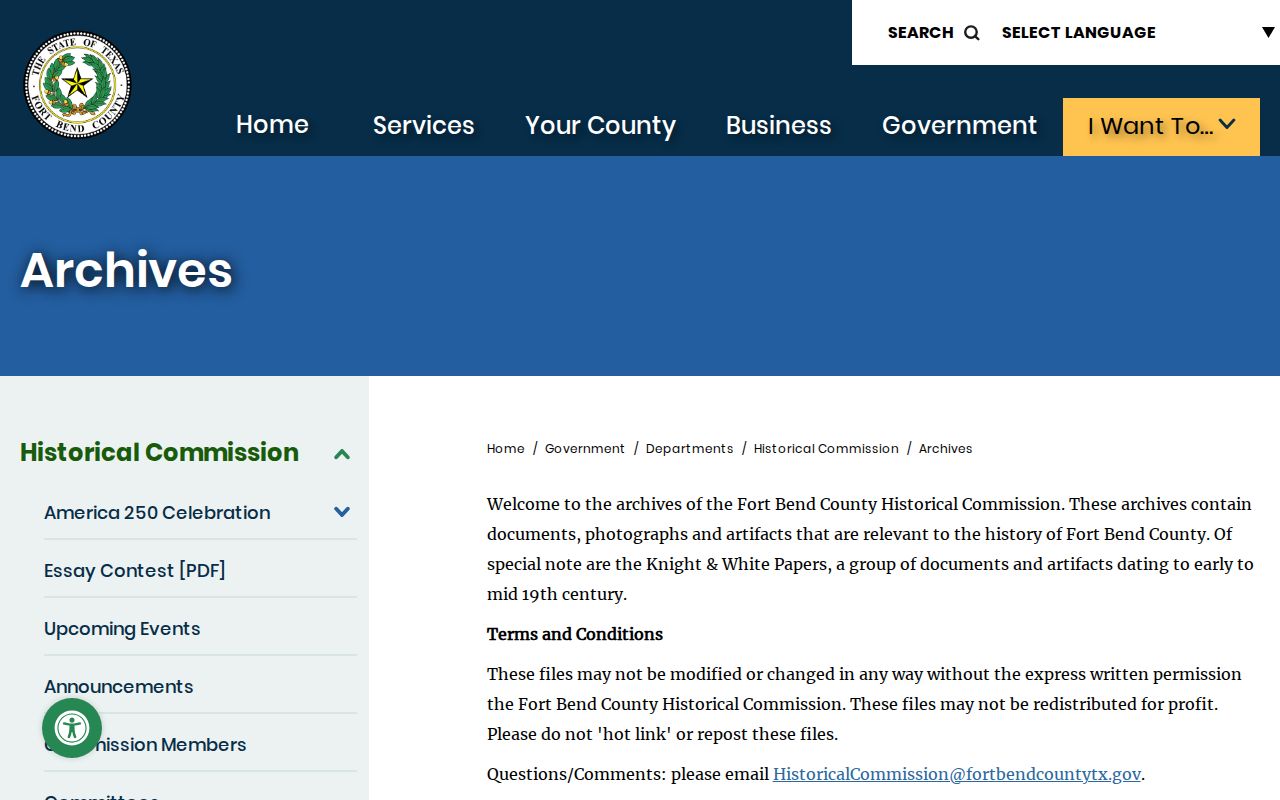
The archive holdings page is a reminder that older Sienna-area research may require a custodian or physical collection.
Sienna Association Document Trail
Sienna's association home and public resource library publish minutes, budgets, audits, declarations, bylaws, and amenity or village material. Those documents help identify the community language that appears in plats and property records. The original SRA villages include Anderson Springs, Avalon, Bees Creek, Shipman's Landing, Steep Bank East, Steep Bank West, and Waters Lake. SCA materials also identify Sawmill Lake, Sienna Oaks, Summerlake House, and Rosewood.
These are governance documents, not a member list. The resident portion is password protected. Texas HOA management certificates can identify an association and management contact, but neither a map legend nor a certificate proves who lives in a home. Use village names as additional parcel-search terms, then return to the official property and instrument sources for any address question.
Sienna Residential Association was incorporated in 1997, according to its public audit, and its association materials describe a managed-community footprint that differs from the Census CDP and developer descriptions. That difference is why population or unit figures should be labeled by source and boundary. Association documents, planning packets, and MUD materials can explain a village or service overlay. They do not convert an HOA or amenity map into a directory of residents, and the public documents should be read alongside the actual declaration for the selected village.
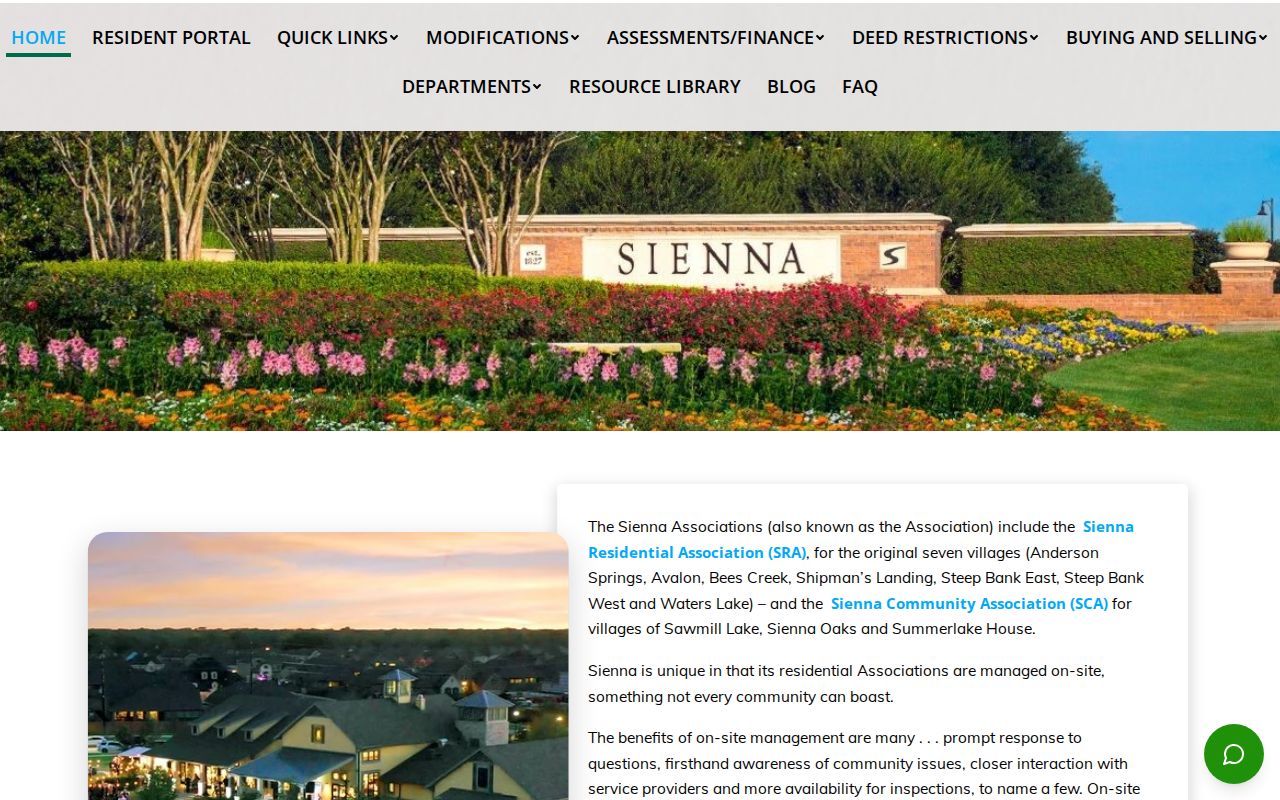
The public Sienna association material supports village and document research without exposing private household details.
Sienna Records Request Route
The Texas Public Information Act, Texas Government Code chapter 552, is the fallback for existing records that are not online. The Missouri City records-request route is one local option once city jurisdiction is confirmed. A request should name the governmental body, record type, Sienna address or parcel, date range, and an instrument or case number when available. Texas recognizes written requests by mail, email, hand delivery, or an approved electronic method. The agency need not create a new resident list or answer an open-ended research question.
Ask for electronic copies and an itemized estimate if charges exceed $40. The general framework calls for prompt production and a response or Attorney General-ruling process within ten business days when records cannot be released immediately. Missouri City directs public-information requests to its City Secretary and Records Request Center, while County Clerk, elections, court, and appraisal records stay with their respective custodians.
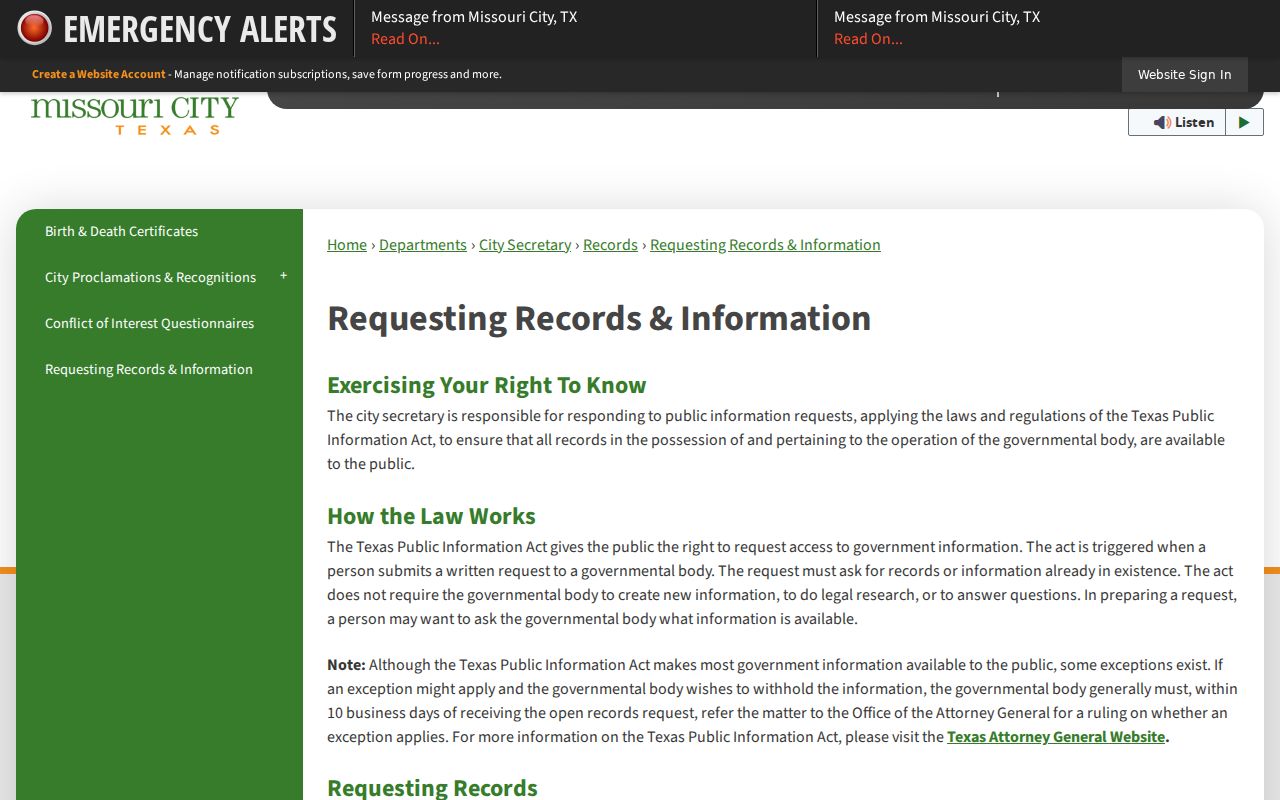
The Missouri City request route is useful only after county and city jurisdiction have been checked for the specific Sienna address.
Sienna Vital Index Boundaries
Vital records are useful family-history leads, but they are not a shortcut to current household information. Fort Bend County Clerk issues qualified local birth, death, and marriage copies. Texas DSHS maintains statewide index and verification routes. Under Texas Government Code section 552.115, a birth record becomes public after its 75th anniversary and a death record after its 25th anniversary. Current copies remain limited to qualified applicants and people with the required legal interest.
The DSHS birth and death summary indexes provide limited fields such as name, event date, county, and sex. Digital birth indexing begins in 1925 and death indexing begins in 1965, while microfiche reaches back to 1903. Marriage and divorce indexes begin in 1966 and 1968. An index is not a certified record, and a DSHS divorce verification letter is not the county court decree. For a locally filed event, ask the County Clerk which order path and eligibility rule applies.
Fort Bend's local birth and death application provides online, mail, and in-person channels. Mail requests require the form, a sworn notarized statement, ID copy, and approved payment. The Sienna Annex is an in-person county service location, but the record holder's current instructions remain controlling. Names in an index can be misspelled, so pair surname searches with a county and event date rather than treating a single hit as a complete family record.
Local and state channels have different fees and issuance rules. Research documented Fort Bend's posted fees as $23 for a certified birth copy, $21 for a first death copy, and $4 for an additional death copy, while DSHS lists a $22 birth certified copy, $22 for a first death copy, and $3 for an additional death copy. Schedules change, so check the issuing office before payment. Marriage licenses come from the County Clerk. A divorce decree belongs with the District Clerk, even if a state verification index supplies a lead.
Sienna Permit and Service Context
A permit or code record can date work at an address without proving who lived there. For Sienna addresses inside Missouri City jurisdiction, MCTX Self Service allows an address search and filters for Permit, Plan, Inspection, and Code Case. The city explains that public summaries can show an applied date, description, issue date when applicable, status, and permit number. More contact or attachment information can require a logged-in record contact.
A failed city search has several possible causes. The work may predate digitization, be under county jurisdiction, use another address form, or fall outside Missouri City's mapped jurisdiction. The county GIS, FBCAD parcel page, MUD and annexation layers, or a focused City Secretary request are better next steps than guessing. City service records describe an address event. They do not create a public resident list.
Missouri City's public map warns that its information applies only to addresses within city jurisdiction. County GIS covers wider Fort Bend layers, including parcels, subdivisions, MUDs, floodplain, schools, roads, facilities, public safety, transit, and mobility projects. Its physical-address verification form goes to the GIS division, while the county identifies CenterPoint Energy for creating or changing an address. Those distinct channels matter because an address question can involve a postal assignment, county validation, city service boundary, or parcel identity at the same time.
Note: Check the complete Sienna address against both county and Missouri City maps before relying on a municipal portal result.
Sienna Record Safety Checks
Records research also has a fraud-prevention side. Fort Bend County offers a free Property Fraud Alert for documents containing a subscribed name, business name, or trust name. A mailed offer for an urgent deed copy is not the same service. Verify an instrument number through the County Clerk index and contact the Clerk through an independently found official number before paying for a document. An index result is a locator, so it should be checked against the image or a custodian copy.
Texas Comptroller ClaimIt searches can be a former-name lead, but they do not establish a current Sienna address. The Comptroller says its claim process is free and does not request banking credentials for a wire or direct deposit. Court, obituary, jury, and jail impersonation scams can borrow a real name or case number. Contact the court, Sheriff, or agency through its published channel, rather than a number or link sent by the caller.
A careful source log reduces both mistakes and overcollection. Save the URL, access date, search wording, result date, record number, fields used, and any redaction. Do not reproduce full birth dates, IDs, protected addresses, or unrelated family details. The minimum needed fact is usually the safest fact to retain.
Texas Address Confidentiality Program participants and qualifying officials can receive statutory protections that hide or substitute residence, phone, birth-date, emergency, or family information. Driver information is separately limited by the federal Driver's Privacy Protection Act and Texas law. A visible field in an old image should not be copied simply because it can be seen. When a record needs correction, request the custodian's amendment process. A deed correction, vital amendment, appraisal update, and court correction each use a different office procedure.
Historic Sienna Directory Routes
Sienna has a modern community boundary, not a nineteenth-century city-directory run. The documented directory route is nearby Richmond and Rosenberg. The Texas State Library catalog lists Rosenberg-Richmond entries for 1962, 1982, and 1986, while the Portal to Texas History collection contains digitized city-directory material but no Sienna-specific item was located. Search the relevant village, subdivision, tract, Richmond or Rosenberg name together with the date.
Older work pairs directory years with census releases, deeds, tax rolls, obituaries, cemetery records, and plats. A printed entry can contain a name, spouse notation, occupation, business affiliation, address, and occupancy mark, but publisher abbreviations must be read before drawing a conclusion. The Sienna directory book keeps the historical collection method separate from current address records.
Texas State Library microfilm supplies a broader Fort Bend bridge: deed records from 1838 to 1886, an index from 1837 to 1897, deed-of-trust records from 1871 to 1887, probate from 1838 to 1877, tax rolls from 1838 to 1910, and historic court or naturalization series. Richmond's 1899 and 1914 Sanborn maps show nearby historical town context, not modern Sienna parcels. For a pre-development tract, use the legal description and nearby locality rather than expecting a modern Sienna street name in a nineteenth-century source.
- Parcel
- A defined property unit used in appraisal and GIS records.
- Index
- A finding tool that points to a record, rather than the record itself.
- Criss-cross directory
- An address- or telephone-ordered directory, if a local run can be located.
- Situs address
- The physical location of a parcel, distinct from its mailing address.
Note: A historical entry is a dated lead, so confirm it against the original image and an appropriate county record.